Oct. 2: Big Food ‘Feeding’ the Hungry Poor? Economic Democracy, Food Justice and Human Rights
Tuesday, October 2, 2018 2:00 p.m. – 3:30 p.m. C.K. Choi Building – Room 120, 1855 West Mall
Join us for a triple book launch to explore the topics of civil society, public policies and the right to food with Andy Fisher (Big Hunger), Annette Aurélie Desmarais (Public Policies for Food Sovereignty) and Graham Riches (Food Bank Nations).
Our speakers include:
Andy Fisher, a founding director of the Community Food Security Coalition in the USA and author of Big Hunger: The Unholy Alliance between Corporate America and Anti Hunger Groups (MIT Press, 2017).
Annette Aurélie Desmarais, CRC in Human Rights, Social Justice and Food Sovereignty, University of Manitoba and co-editor of Public Policies for Food Sovereignty: Social Movements and the State (Routledge, 2017).
Graham Riches, emeritus professor of social work, UBC and author of Food Bank Nations: Poverty, Corporate Charity and the Right to Food (Routledge, 2018).
Moderated by Laura Castrejon Violante, ISGP PhD student, Land Use and Global Environment (LUGE) lab, School of Public Policy and Global Affairs and Liu Scholar.
Copies of books will be available to purchase. Light refreshments will be provided, please RSVP.
Co-hosted by: UBC School of Social Work, UBC School of Public Policy & Global Affairs, the Liu Institute for Global Issues, the Food Systems Network (a Liu Scholars and CSFS group), and the Centre for Sustainable Food Systems (CSFS) at the UBC Farm.
Market Recipe Blog: Herby Apple Stuffing
By Joyce Liao on October 2, 2018
Market Recipe Blog: Herby Apple Stuffing
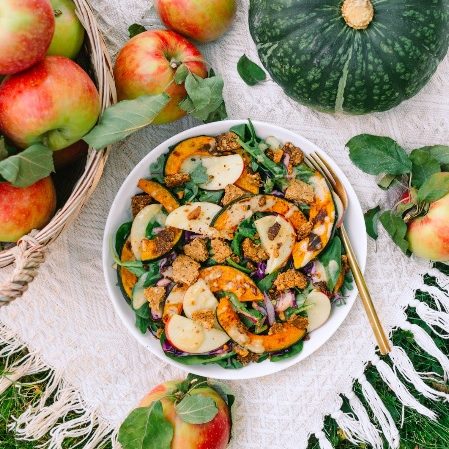
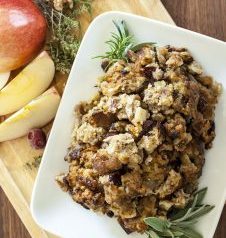
Herby Apple Stuffing
One of the most frequently-asked questions at market is: what do I do with this herb? Buying a whole bunch can be intimidating but this recipe provides a great excuse to use them up and bask in the incredible aromas that will fill your kitchen in the process! Apples bring a delicious tart brightness to this stuffing recipe and are balanced well by sweet walla walla onions and fragrant farm herbs. And you heard it here first: stuffing isn’t just for Thanksgiving, you can make it any time you want!
Yield: 8 servingsRecipe
- 1 large walla walla onion
- A few stalks of celery or 2 Tbsp fresh lovage herb
- 2-3 tart apples (UBC Farm varieties Margil, Poppy’s Wonder, and Sundance are a great fit)
- 1 cup vegetable stock or chicken broth
- 1 egg (or substitute for 1 Tbsp ground flax or chia seed mixed with 2.5 Tbsp water and left to rest for 5 minutes)
- 1/2 bunch each of fresh thyme, sage, and rosemary
- 1/2 bunch parsley
- 1/2 cup toasted and chopped nuts (walnuts, pecans or pine nuts are a favourite)
- 2 loaves of bread or gluten-free bread (something with a lot of crust, like a baguette, works well)
- 5 Tbsp butter or olive oil
Instructions
- Preheat oven to 350F. Chop or tear bread into 1″ cubes and spread on a baking sheet. Stir occasionally and bake until lightly toasted, 10-15 minutes. Let cool.
- Grease a baking dish (like a loaf pan or 9″ square dish) with butter/oil.
- Melt butter/oil in a large pan on medium heat and sautée chopped onion, chopped herbs (except parsley), salt and pepper until onions are translucent. Add celery or lovage for few minutes until tender, then add and cook chopped apple until it is tender. Remove from heat.
- In a large bowl, mix toasted bread cubes and sauteéd vegetables together. Pour whisked egg (or flax/chia egg) and stock/broth over top. Stir in chopped parsley and nuts. Let set for a few minutes as the bread absorbs liquid. Add a bit more broth if it looks too dry. Spoon into the greased dish.
- Bake for 30-45 minutes, until brown on top and cooked through or use to stuff a turkey and cook that way.
Pick up produce at any of our three weekly markets: Tuesdays 4-6:30PM at the UBC Farm, Wednesdays 11:30AM-1:30PM at the UBC Bookstore, and Saturdays 10AM-2PM at UBC Farm. Learn more about our produce and browse other recipes in our Market Recipe Blog. Recieve regular market recipes from our newsletter here.
Saturday Market Vendor Feature: Brazilian Roots Food Truck
By rachel ma on October 2, 2018
Saturday Market Vendor Feature: Brazilian Roots Food Truck
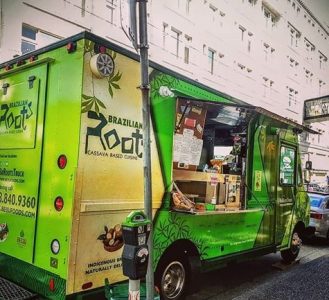
Marketgoers will recognize returning food truck Brazilian Roots, which sells beiju, an indigenous flatbread traditional to Brazil made with cassava flour and naturally plant-based and gluten-free. Come out for their last market date of the 2018 season and try your own: you’ll find it filling and flavourful, sweet or savoury, and always served with a smile from friendly owner Luciano!
How did your business start and what drives you?
Beijú Foods is a Canadian company proudly founded in BC by Brazilian immigrants to honor their roots and promote the best of Brazil’s creative and flavourful food culture. Beijú Foods is focused on indigenous culinary traditions, native crops, and its fusion with African and European cuisine during Brazil’s colonization. Above all, we are passionate about ancestral cultures that are simplistically rich, and that can show us how to live harmoniously with our ecosystems, and to adapt to challenging situations. Our mission is to bring new, healthy and sustainable food alternatives to your daily life so you can enjoy a healthier diet with exotic ethnic flavours. Beijú Foods main core values are Quality, Sustainability, and Community. We source our products from carefully chosen premium suppliers, who work at fair ethical conditions that are sustainable for the community and the planet. High quality and sustainability also mean health – our products are gluten-free, non-GMO and minimally processed to avoid the use of artificial ingredients and preservatives. Also, we invest in the latest packaging technology to keep our products fresh and 100% natural. We actively advocate for indigenous rights and the environment. We believe in a more respectful and holistic connection between individuals, communities, cultures and nature.
What do you sell from your food truck?
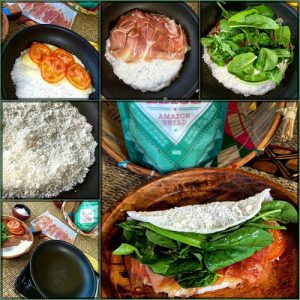
Our featured item is Beiju – an indigenous gluten-free flatbread, made one hundred percent from cassava. Boost its nutrients by adding seeds and nuts, as well as fillings like meat, cheese, fruits and vegan options. Baking a beiju is a magical trick that is healthy and delicious! The Brazilian Roots Truck also offers other “forest foods”, like açaí smoothies, yerba mate and guaraná. We also serve cassava based bread, cassava cheese balls (pão de queijo), paninis and other seasonal options. In addition to offering a fusion of traditional Brazilian flavours, our kitchen pays special attention to nutrition and will strive to make recipes as healthy as possible, using wholesome local ingredients.
What is cassava flour?
Cassava (Manihot esculenta) is a shrub original from Brazil whose roots are edible. It was used for thousands of years as a main source of energy by the pre-Colombian population of the Americas. Nowadays, it is common to find indigenous arts that make references to this plant, as it is a vital part of their lives. In the 16th century, Portuguese traders took cassava to Africa and today no other crop is as important as a food source for the resource-poor African regions. In Asia, cassava also became a staple foods and Thailand is currently its biggest world producer, followed by Vietnam and Indonesia. As a drought-resistant crop that does well in poor soils, cassava is a starch-heavy lifesaver for low-income areas throughout the world. Cassava and its vast spectrum of sub-products and recipes are still one of the main staple foods in Brazil, and the most famous Brazilian dishes have some form of cassava component in them. Cassava permeates all Brazilian social classes: it was the base of slaves’ meals until the 19th century and is still a daily resource for Brazil’s poorer populations, nonetheless higher classes also eat cassava broadly and daily. Lately, cassava has gained a strong popularity with athletes and other functional diet seekers because it is such a great and pure source of energy!
If you want to learn more about the Brazilian Roots Truck, check them out on instagram, facebook, or their website. You can see all of their upcoming dates at the UBC Farm Market here. Learn more about other market vendors and topics on our Saturday Farmers’ Market blog! These weekly market blog posts are linked from our newsletter when they are posted; to get regular updates, make sure to join our newsletter here.
Market Recipe Blog: Potato Broccoli Cheez Soup (GF + V)
By Joyce Liao on September 25, 2018
Market Recipe Blog: Potato Broccoli Cheez Soup (GF + V)
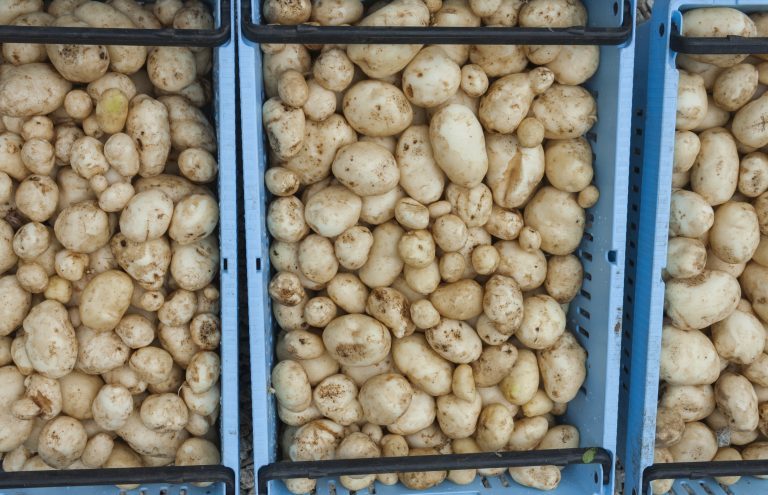
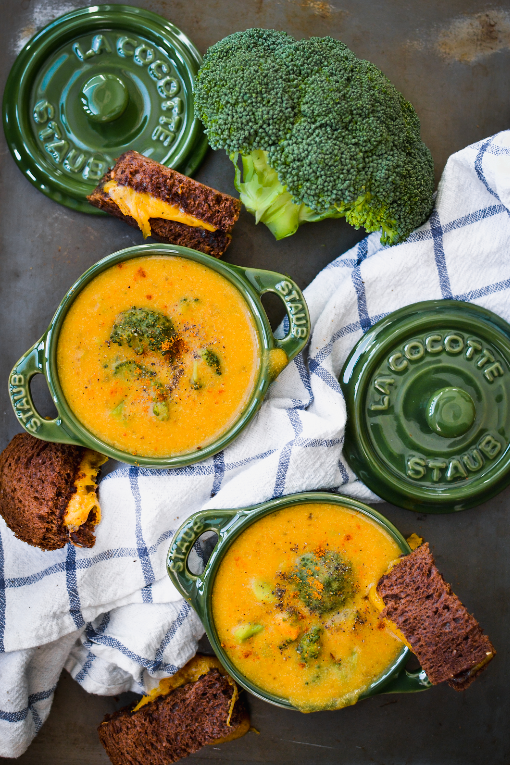
As a kid, broccoli cheese soup is one of my favourites in the winter months. The secret ingredient to a silky smooth soup without the dairy is a good ol’ potato! This root vegetable has always been super versatile and provides substance into any meal. Not only that, but potatoes are a great source of many vitamins and minerals and fiber for digestive health.
Potato Broccoli Cheez Soup (Gluten-free & Vegan)
Recipe
- 1 carrot, chopped into chunks
- 1 yellow potato, cubed
- ¾ cup nutritional yeast
- 2 cups water + 2 cups water, divided
- 1 tbsp mustard
- 2 small crowns broccoli
- Salt, freshly cracked pepper, paprika to taste
Instructions
-
- In a medium pot, cook chopped potatoes and carrots in boiling water until soft.
- Keep the water you used to boil the potatoes and carrots to use as the soup base for later, so you don’t need to use broth!
- In a blender or food processor, add in the cooked potatoes, carrots, nutritional yeast, 2 cups of the saved starchy water used to boil the potatoes/carrots, and mustard. Blend until smooth.
- Pour the cheezy mixture back into the pot and add in broccoli and the additional 2 cups of water to thin it into a soup consistency. Add in additional water or broth to reach the consistency you like.
- Bring to a boil to cook the broccoli. You can choose to blend up the broccoli with an immersion blender if you wish, but we left the soup chunky as pictured.
- Serve immediately with some cheesy soldiers or toast!
Pick up produce at any of our three weekly markets: Tuesdays 4-6:30PM at the UBC Farm, Wednesdays 11:30AM-1:30PM at the UBC Bookstore, and Saturdays 10AM-2PM at UBC Farm. Learn more about our produce and browse other recipes in our Market Recipe Blog. Recieve regular market recipes from our newsletter here.
Saturday Farmers’ Market Vendor Feature: Neighbourly Bee
By rachel ma on September 25, 2018
Saturday Farmers’ Market Vendor Feature: Neighbourly Bee
This week at the UBC Farm Farmers’ Market, Neighbourly Bee will be pouring their local blueberry blossom honey on tap. Bring you favourite honey jar and fill up with this honey at $14/lb. Here are some questions we asked to find out more about Neighbourly Bee!
What makes your honey different from the honey we get at grocery stores?

Owner Riana with the bees she cares for
Our honey is harvested in small batch extraction, giving us the opportunity to characterise our honey by season and floral source. Always raw, unfiltered and of course 100% Honey. Neighbourly Bee honey is harvested and identified by areas, giving unique and distinct flavour from season to season; this allows me to be more specific with taste profiles reflecting the true essence of what specific nectar sources provide.
Is your blueberry blossom honey from the blueberry plant?
Yeah! To get blueberry honey, the bees visit blueberry flowers and collect the nectar and convert it to honey. Through that process blueberry bushes are also pollinated. Did you know that a pollinated blueberry bush will yield ten times as much fruit!
I notice that your alfalfa clover honey looks sort of like a creamed honey. Is it a creamed honey? What’s the difference between your blueberry blossom versus your alfalfa clover honey?
The alfalfa clover honey is actually not creamed. It is made from alfalfa and sweet yellow clover nectar. The characteristics of this nectar creates a white, creamy, light honey. The origin of the flower is a direct correlation of the characteristic of the honey. The blueberry blossom honey, for example, comes from blueberry flower nectar. Both these honeys are 100% honey but have a different colour, texture and taste.
Where’s your bee farm?
Our Apiary (which is the word for a honeybee farm) is located on Byrne Rd. We share our space with Seed of Life; who grows vegetables and also sell their produce at the UBC Farm! We make a point do this as a collaboration in order to practice the relationship required between farmers and beekeepers for a sustainable and healthy ecosystem.
How long have you been bee keeping?
This is my second season, so two years!
Is it just you who owns Neighbourly Bee?
Yes, it’s just me for now!
How did you get into bee keeping?
I just really like bees and they are super cute. I love playing a role in our local food system and working with farmers to find a way to continually be innovative with our farming practices; especially when it comes to effective ways to work together.
What brought you to the UBC Farm?
I liked that the UBC Farm is on a working farm. I think its exciting for people to be able to visit a farm and see where the food is coming from. I was also excited to be beside my farm mates, Seed of Life!
What would you like your customers to know about your business?
Neighbourly Bee is a place for you to get 100% honey and to learn more about bees and pollination. I’d like people to understand the collaboration between the farmers and beekeepers. We really have to work on the same page and be transparent about pesticide and fungicide use so that we can create a sustainable way of beekeeping and farming. Currently, there are some conflicts between pesticide-use that hurts the bees.
Anything else you want to share?
Our farm is open to the public and we love visitors. You can follow us on social media or check our website www.NeighbourlyBee.com to stay up to date with our hours, store, events and classes. We will be doing a beekeeping course this fall and again in the spring. We will also be launching the areas first community beekeeping space. This is an area on our farm where you can keep your own bees. It’s a great opportunity for anyone who would like to get into beekeeping but doesn’t have an area of their own; or anyone who is interested in keeping but would like to be connected with tools, resources and a community of beekeepers.
If you want to learn more about Neighbourly Bee, check them out on their website and instagram. You can see all of their upcoming dates at the UBC Farm Market here. earn more about other market vendors and topics on our Saturday Farmers’ Market blog! These weekly market blog posts are linked from our newsletter when they are posted; to get regular updates, make sure to join our newsletter here.
Saturday Farmers’ Market Vendor Feature: Blue Valley Farm
By rachel ma on September 18, 2018
Saturday Farmers’ Market Vendor Feature: Blue Valley Farm
Regular visitors at our Saturday Farmers’ Market will recognize Blue Valley as a long-time vendor. Their colourful and flavourful fruits and vegetables are a favourite among our market community. We had a chance to talk to owner Dave Perry about his farm and why they have been coming back to the UBC Farm Market for so many years!
Could you tell me the story of how and why you started your business?
Blue Valley farm is a a family-owned 5 acre farm, and we’ve been farming for 15 years. I came from a farming family, so that’s how we started this business.

Cabbage growing at Blue Valley Farm
Why do you encourage people to eat your produce?
Because we don’t use pesticides and you can be sure that it is high-quality and healthy for not only us but the environment.
What types of products do you sell?
Plums, apples, nectarines, cherries, tomatoes, zucchini, garlic, onions, peaches
What kind of customers do you target?
Pretty much anyone who wants to eat fresh and healthy produce!
What encouraged you to sell your products in the UBC farm?
We’ve been at the UBC farm for a decade; we love it here!
Have you had any memorable experiences in the UBC farm?
Good musicians; the experience is more or less the same every week! There’s a better demographic here and the people are truly here to support local business and shop for the week, so produce is easy to sell!
If you want to learn more about Blue Valley Farm, check them out on instagram. You can see all of their upcoming dates at the UBC Farm Market here. Learn more about other market vendors and topics on our Saturday Farmers’ Market blog! These weekly market blog posts are linked from our newsletter when they are posted; to get regular updates, make sure to join our newsletter here.Saturday Market Volunteer Feature: Fred Fromm
By rachel ma on September 18, 2018
Saturday Market Volunteer Feature: Fred Fromm
We know that one of the main reasons people love to visit the UBC Farm Saturday Farmers’ Market is the community: chatting to vendors, seeing friends, spending time with family, and meeting new people. One of the people most marketgoers have likely had a chance to meet is our weekly info table volunteer, Fred Fromm!
Fred is now in his second year volunteering at the market and does an incredible job boosting the market team’s morale, encouraging shoppers to treat themselves to something special, and making everyone who comes through the farm gates feel welcome. Fred’s last day for the 2018 season is coming up this week so we took the chance to ask him a bit more about himself. Come out this Saturday Sept 22 to say hi, let him know how much you appreciate him, and wish him the best on his travels to Europe in October

Fred in green at the info table at market
I would love to hear how you first heard about the Farm and what interested you in coming out?
Well I just moved into the neighbourhood and one Saturday morning I went for a walk and I noticed there’s a UBC Farm. I came in, I looked around, and I noticed there was a UBC Farm tour, and it was actually at 11 o’clock then [free Saturday tours now run at noon] so I thought, “Well I’ll take the tour.” During the tour, Katherine said, “If you want to volunteer, you have to go to the website and take the volunteer orientation,” which I did and then I started picking strawberries. Then it led me to blueberries and then led me to beans and then led me to seeing on the site one day, there was an opportunity for doing Saturday morning. So I quickly put my name down and that’s how I came to do Saturday mornings.
So when you first moved to Vancouver, why were you interested in a farm? What was your background that drew you to farming?
It wasn’t a move to Vancouver but when I was growing up in Saskatchewan to make ends meet, we weren’t very rich, my parents and us as a family had a garden in the city and we had a plot of land outside the city on someone’s farm. We took a bit of the home acreage and made it a parcel of garden. So from 4 or 5 years of age I was out in the garden planting, picking, and it was just something we did to grow vegetables. And I missed it because after we started to work, well I wasn’t in a climate to do that, so for thirty some years I didn’t do that and I saw this, and said “This reminds me of Saskatchewan!”
What are a few of the things you like most about being at the market, helping out here?
Getting to meet all of the people that come in, especially the regulars, and the new people who know nothing about the UBC Farm. So when I come in, I like to work five to eight feet in front of the stall, that’s me. Not behind the counter. Come in, promote the farm, talk to [people], point things out, and like the Wal-mart greeter, I think people feel “I’m welcome.” I’m surprised at how many people are new; mostly surprised how many people use the stamp card: “Well, maybe I won’t,” and in a little while they’re back with all five stamps. And as I talk to some of the market vendors, they notice that people have stamp cards. In fact, now some of them send them: “Oh you don’t have a stamp card, go and get yours, because if I sell to you, then maybe you want the next person to sell to you, and we all benefit.”
This is your second summer helping at the market, have you noticed any changes last year to this year?
It’s gotten bigger, it’s gotten busier, and there’s a much wider mix of vendors selling things. It’s not just fruit and vegetables, it’s products they make to sell, things that maybe wouldn’t get shelf space anywhere else that they come here to sell. I’ve noticed that there’s a lot more local folks who are living here now coming and saying, “Oh, what’s this?”
If someone was new to the market or hadn’t even been to the market, what would you tell them is a great reason to start shopping at our Farmers’ Market?
I think they will find that the quality of the produce and the knowledge of the vendor – where it came from and how it was grown – makes it far more superior than shopping at the local food or vegetable mart or supermarket etc. for the thing. When you can actually sometimes go out and pick your own for u-pick it just makes it that much more enjoyable and that’s why I see for these days of u-picks for strawberries and blueberries, huge number of people, because “I want to bring my kids and let them pick.”
You can find Fred at the Saturday Farmers’ Market info tent every Saturday until September 22 2018. Come say hi or look for him next summer! Learn more about other market vendors and topics on our Saturday Farmers’ Market blog! These weekly market blog posts are linked from our newsletter when they are posted; to get regular updates, make sure to join our newsletter here.
Saturday Farmers’ Market Vendor Feature: Humblebee Meadery
By rachel ma on September 11, 2018
Saturday Farmers’ Market Vendor Feature: Humblebee Meadery
This week at our fall fair, we are featuring Humblebee Meadery, founded and handcrafted right here in Vancouver! This local business is mixing incredible flavours like saffron and orange with gifts from the humble honeybee. What is mead, you ask? Read on to find out more about this innovative local business and their delicious mead.

Humblebee Co-owners, Jeff and Pierre
Who is Humblebee Meadery?
The two humans behind Humblebee Mead are Jeff Gillham and Pierre Vacheresse. They wanted to bring back mead, one of the oldest alcoholic beverages, back to the table updated with their 21st century twist!
What is mead?
Mead is a light, refreshing, gluten-free alcoholic drink made from fermented honey!
What’s special about humblebee?
Humblebee has re-crafted this drink that has been around for centuries to suit the 21st century palate. The resulted desired beverage is through the infusion more aromatic flavours, carbonation and an alcoholic volume of 5.5%.
What are the different flavours to choose from?
There’s the original “The Bees Knees”, which was their first Eureka moment, and “The Champion of the Sun” came after that, which has an amber colour and floral flavour profile. They have also partnered up with Wayward Distillery, another vendor you can find at the UBC farm this season, creating several cocktail recipes for your enjoyment on their website!
Where else can I find Humblebee Meadery?
They are located at 1575 Vernon Drive in Vancouver, but within Vancouver, they also have retail locations at several private liquor store, as well as in restaurants such as Storm Crow Alehouse and Burgoo! Check their website for more details of specific retail locations.
If you want to learn more about Humblebee Meadery, check them out on instagram, facebook or their website. They will be at the UBC Farm Saturday Farmers’ Market next on September 15, September 29, and October 20, 2018. Learn more about other market vendors and topics on our Saturday Farmers’ Market blog! These weekly market blog posts are linked from our newsletter when they are posted; to get regular updates, make sure to join our newsletter here.
Market Recipe Blog: Tahini Kale Quinoa Salad
By Joyce Liao on September 11, 2018
Market Recipe Blog: Tahini Kale Quinoa Salad
Tahini Kale Quinoa Salad
This is the kale salad that all my friends request me to make whenever we hold a dinner party. I’ve also made this salad for youth I worked with over the summer, and they all said it was the best salad they’ve ever had! So if you need a reason to pick up some kale from the farmer’s market this week, look no further.
Yield: 4 servingsRecipe
SALAD
- 2 large bunches kale
- 1 cucumber, sliced
- 1 can chickpeas, drained
- ¾ c. quinoa, uncooked
- 1½ lemon, juiced
- ¼ c. tahini
- 1 tbsp. miso paste
- 2 tsp. dijon mustard
- 2½ tbsp. maple syrup*
- water, as needed
Instructions
- In a small pot, cook quinoa according to package instructions.
- Roast chickpeas on a baking sheet at 375°F for about 15 to 20 minutes. You can toss with a bit of oil, salt, and pepper if desired.
- Meanwhile, wash and spin kale dry and massage through washed kale with lemon juice.
- Set the kale aside to “break down” from the lemon juice while you prepare the dressing.
- For the dressing, add in all the ingredients into a small bowl and mix. Add in water to attain a yogurt consistency. Make sure it isn’t too thin because massaging the kale with the thick dressing really makes the kale more palatable and less “chewy”. Adjust to taste.
- Pour dressing into the salad and massage the kale until everything is incorporated.
- Toss in the remaining toppings (quinoa, cucumber, chickpeas) into the salad and enjoy immediately or store in the fridge in an airtight container to enjoy later.
Pick up produce at any of our three weekly markets: Tuesdays 4-6:30PM at the UBC Farm, Wednesdays 11:30AM-1:30PM at the UBC Bookstore, and Saturdays 10AM-2PM at UBC Farm. Learn more about our produce and browse other recipes in our Market Recipe Blog. Recieve regular market recipes from our newsletter here.