Sept. 11: Women, the right to land and resources, and the political-humanitarian crisis in Nicaragua with Martha Sánchez
Tuesday, September 11, 2018. 12 p.m. – 1 p.m. MacMillan Building Room 350, UBC.
Women, the right to land and resources, and the political-humanitarian crisis in Nicaragua by the activist and gender specialist Martha Sánchez.
About the seminar:
In her presentation, Martha will describe the current socio-political crisis in Nicaragua; more than 300 people have been killed since the protests erupted in April. Martha will explain how this crisis affects women’s lives, especially, their rights to live free from violence and with access to land and productive and economic resources. Martha will also talk about the challenges confronted by the Miskito and Mayangna Indigenous Peoples in northern Nicaragua.
About Martha Sánchez
Martha Sánchez is a young feminist committed to the defense of women’s rights. She has a degree in International Affairs from the Universidad Nacional de Nicaragua, and currently pursues a Master in Gender and Development at the University of Cataluña, Spain. Martha has worked with Oxfam in its Active Citizenship of Women and Youth Program since 2011, which aims to empower women in their demands for economic, sexual and reproductive rights, and their right to live free from violence. Since 2016, Martha has been a member of the Women Deliver Young Leaders Program, a global advocate organization for girls’ and women’s health, rights and wellbeing. Earlier this year, Martha traveled into the Bosawás Biosphere Reserve as a gender consultant for the Canadian NGO Change for Children to deliver gender equality workshops in remote Indigenous territories.
This talk is presented by the Centre for Sustainable Food Systems.
Market Recipe Blog: Zucchini Bread
By Joyce Liao on September 8, 2018
Market Recipe Blog: Zucchini Bread
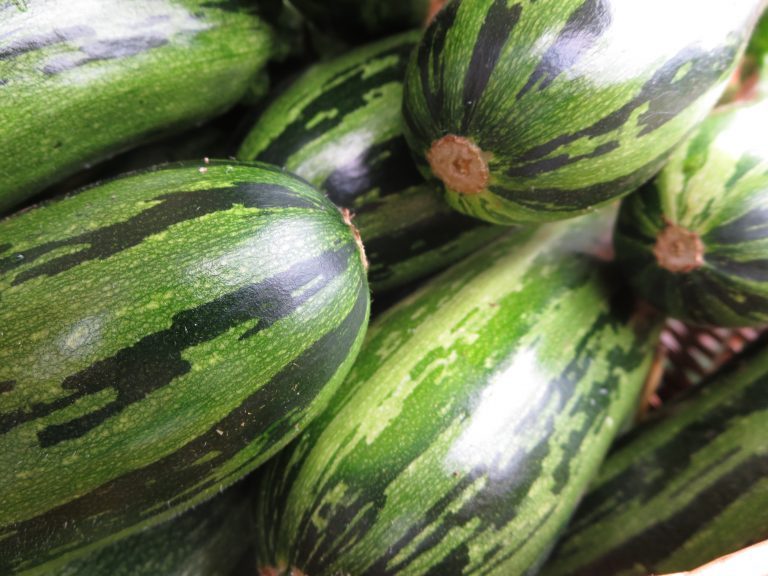
Zucchini is one of the most versatile summer veggies, and while they may be abundant in summer they won’t be around forever so now is the time to take advantage: you’ll be sure to find some at the UBC Farm markets this week!
Not only are they great in simple stir-frys, tossed in a baking tray for roasting, or spirallized into a zoodle dish, they can be used in sweet recipes as well, like this zucchini banana bread we’re sharing today. This bread is perfect for a quick on-the-go breakfast, slathered with your favourite nut butter, or packed in your bag to fuel those mid-afternoon slumps.
Zucchini Banana Bread (Vegan)
Zucchini bread is one of my favourite ways to enjoy zucchini season and sneak some veggies into my baking. It keeps the loaf moist, and bananas make the loaf naturally sweet, making it totally justified to have cake for breakfast!
Yields: One 8” loafRecipe
- 2 ripe bananas, mashed
- 1 cup grated & squeezed zucchini (about 1 medium zucchini)*
- ¼ cup vegetable oil
- ¼ cup almond milk
- ½ cup brown sugar
- 1 tsp vanilla extract
- 1½ cups all purpose flour
- ½ cup whole wheat flour (or more all purpose flour)
- 1 tsp cinnamon
- ¼ tsp nutmeg
- 1 tsp baking soda
- ½ tsp salt
- ½ cup chocolate chips
Instructions
- Preheat oven to 350°F and line an 8″ loaf pan with parchment paper.
- In a large mixing bowl, whisk together mashed banana, zucchini, oil, milk, sugar, and vanilla.
- Add the flours, spices, baking soda, and salt and use a spatula to combine. Mix in chocolate chips.
- Transfer batter to prepared loaf pan and top with a few more chocolate chips.
- Bake in preheated oven for 60 minutes or until golden brown and a toothpick inserted into the center comes out clean or with just a few moist crumbs.
- Cool completely before slicing for the cleanest cut.
Notes
*Do not skip the squeezing or you’ll end up with a gummy loafPick up produce at any of our three weekly markets: Tuesdays 4-6:30PM at the UBC Farm, Wednesdays 11:30AM-1:30PM at the UBC Bookstore, and Saturdays 10AM-2PM at UBC Farm. Learn more about our produce and browse other recipes in our Market Recipe Blog. Recieve regular market recipes from our newsletter here.
Saturday Farmers’ Market Vendor Feature: Wayward Distillation House
By rachel ma on August 28, 2018
Saturday Farmers’ Market Vendor Feature: Wayward Distillation House
One of our regular vendors for the last two seasons, Wayward Distillation House, is changing the way people think about spirits in the UBC Farm Market community. With incredible flavours and dynamic uses for drinking or cooking, Wayward sets themselves apart through their commitment to sourcing their ingredients from local growers. We spoke to co-owner Dave Brimacombe about why the honey he uses needs a consistent floral source, why he loves farmers’ markets, and what curious visitors should try (including a garlic and ghost pepper vodka)!

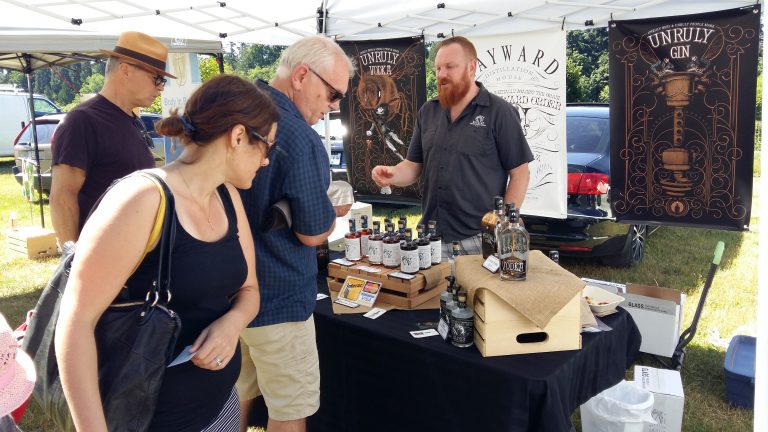
Dave at market, talking to shoppers
What got you passionate about this business?
I spent a lot of time traveling the world looking into regional booze; like what people choose to spend their time with, in their leisure time. What they want to make, what they want to drink. I was fascinated by the alchemy behind alcohol. Then I started tinkering with home fermentation, making my own wine, beer, cider and mead and then, being inquisitive, it was just a natural progression to start into distilling. Distilling at home is a federal crime so I had to take that step to go professional or be a rumrunner I guess!
How did you end up selling at farmers’ markets? Where did that choice come from and what makes you want to keep on selling here?
Craft spirits are new to the average human being. We’ve been sold “big-budget spirit” for years and years and years and spirits made by hand with local ingredients are just sometimes unapproachable to an uneducated consumer. So farmers’ markets are a chance for me to just talk to human beings and pour my spirit into their hands and talk and educate. So I view markets as an education platform. A place for me to just talk to people. So selling a bottle is an added bonus. And then being here at UBC is great, we’re out here in the middle of the farm, it’s super cool, people are a little more relaxed. And if you consider that I want to talk to people it’s nicer when there’s not 37 people lined up at the end of my booth.
What about your ingredients? How do you make choices about what goes into it and how does that embody what your values are around your product?

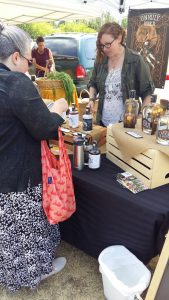
Co-owner Andrea offering samples at market
So we use farmers’ market product whenever possible. When I first started doing recipe development I opened my business in December, so I missed the growing season, I didn’t even know, so I went to the store and bought ingredients for recipe development. My very first year, as we started to go through the growing seasons, I started replacing store-bought products with hand-grown products – we’re talking ingredients, flavourings, everything – and the difference was astronomical. I had to re-tool my recipes because the stuff grown with love was just so much better. So I started working with that and now I support other small growers: all of our berries come from local growers, all our garlic comes from local growers, stuff we can’t get from here we buy from ethical growers. So our coffee, chocolate, and vanilla all come from Common Ground.
What about your honey?
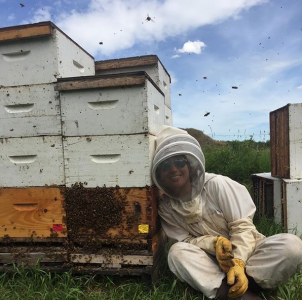
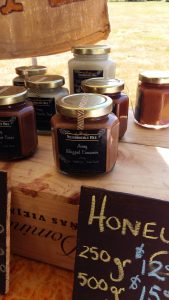
One farm. Sole source, it’s not certified organic but he only pollinates organic and pesticide-free crops; likes his bees more than people so that’s super cool. And once again, we can use the same story about starting a business in December and there’s not a lot of honey out there from farmers left over so as we were doing recipe development the real honey just was so much better. And then for me, honey is key, it’s what we make everything out of, and we don’t think about it but those minor differences in floral honeys are concentrated when you ferment and exaggerated when you distill so having a reliable source of honey is key, it’s got to be the same. So that’s why we formed a partnership with one farm in Tomslake and all of our honey’s theirs. It’s unpasteurized and unfiltered.

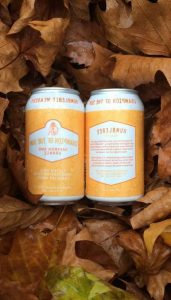
Wayward’s spirit with the most broad appeal
If someone was new to spirits, or new to craft spirits, what would you suggest as a starting ground from what you have on the table today?
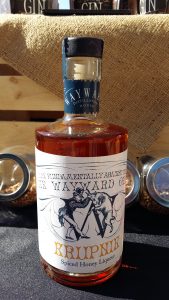
Well every palate is different, every drinker is different. We find the Krupnik, our spiced honey liqueur, seems to have broad appeal: a lot of people like it. If you’re a gin drinker, of course the Unruly Gin, and if you’re into something experimental we’ve got a raw garlic vodka. It might not be the entry-level spirit but definitely something to play with if you’re cooking and drinking. Launched it yesterday: garlic and ghost pepper!
Anything else to share?
Just try it. That’s the biggest thing that I find when I run into guests is that hesitancy to try. Once they’re sampling, they’re good to go, but it’s that first sip or that horrific gin experience from their teens (I love that story, I hear that all the time). Try mine, it’s different!
If you want to learn more about Wayward Distillation House, check them out on instagram, twitter, facebook or their website. They will be at the UBC Farm Saturday Farmers’ Market next on September 1, September 15, September 29, October 13, and October 27 2018. Learn more about other market vendors and topics on our Saturday Farmers’ Market blog! These weekly market blog posts are linked from our newsletter when they are posted; to get regular updates, make sure to join our newsletter here.
Market Recipe Blog: Beet Hummus
By Joyce Liao on August 28, 2018
Market Recipe Blog: Beet Hummus
Beet season is in full swing here at the UBC Farm, and we couldn’t be any more excited! Here are some reasons why:
- Both the greens and the beetroot are edible. The beetroot and its greens are both an excellent source of folate, vitamin A and K, and a very good source of manganese, copper, and potassium.
- Beetroot juice is one of the richest dietary sources of antioxidants and naturally occurring nitrates (not to be confused with nitrites!) that improve blood flow.
- Beets add colour to the plate! There are red, golden, and chioggia (pink striped) beets. They can all be used interchangeably in your favourite recipes!
- Beets, with the tops removed, can be kept in the fridge 2-4 weeks, so they are the perfect vegetable to have on hand if you know you’re short on time to grocery shop in the next week. Just make sure to remove the beet greens from the beet root so they won’t draw moisture from the beet.
Beets make a pretty un-beet-able veggie to incorporate into your daily diet, so if you’re still stumped on what to do with those beautiful beets you saw last week at the farmer’s market, here’s one of our favourite ways to eat it!
Beet Hummus
If you love hummus, you’ll love this creamy balsamic beet hummus. It’s perfect to have on-hand in the fridge anytime you have a snack attack with some veggies or crackers, or when you need a spread to fix yourself a quick sandwich for lunch! Yield: 2.5 cups hummusRecipe
- 1 medium beet, diced
- 2 cloves unpeeled garlic

- 1 cup dry red lentils
- 1 tbsp olive oil + more for roasting
- 1 tbsp balsamic vinegar
- 2 tbsp fresh lemon juice
- ¼ cup tahini
- ½ tsp sea salt + more to taste
- Black pepper to taste
- Balsamic glaze, to garnish
Instructions
- Preheat oven to 400°F and line a baking tray with parchment paper.
- Toss diced beet and garlic cloves in a bit of oil and a pinch of sea salt and black pepper. Roast in oven for 25 to 30 minutes, or until fork-tender. When cool enough to handle, peel the cloves of garlic.
- Meanwhile, cook the lentils in a medium pot with a generous 3 cups of water according to package directions. Once cooked through, drain thoroughly.
- In a food processor, blend the cooked lentils, roasted beet, peeled garlic, 1 tbsp olive oil, balsamic vinegar, lemon juice, and tahini. Adjust consistency and flavours by adding more oil, lemon juice or balsamic, salt, and pepper to taste.
Pick up beets at any of our three weekly markets: Tuesdays 4-6:30PM at the UBC Farm, Wednesdays 11:30AM-1:30PM at the UBC Bookstore, and Saturdays 10AM-2PM at UBC Farm. Learn more about our produce and browse other recipes in our Market Recipe Blog. Recieve regular market recipes from our newsletter here.
Saturday Farmers’ Market Vendor Feature: The Raw Guy
By rachel ma on August 21, 2018
Saturday Farmers’ Market Vendor Feature: The Raw Guy
Who is “The Raw Guy”? Brian, a gourmet raw food chef and advanced raw food nutrition educator, started the business just over 7 years ago with a passion for community and the benefits of raw, organic and vegan food that everyone will love.
The Raw Guy a part of the Feeding Growth progressive food business community and a new vendor at the UBC Farm Market for the 2018 season. These spreads, crackers, sweets and kale chips have piqued the taste buds of many in our market community already so we got a chance to ask Operations Coordinator (and “raw guy pal”) Catherine more about the business.
What is your business name and how long has it been in operation?
Brian started the business just over 7 years ago. Brian attended Living Light culinary school prior to that and truly found his passion. With having his own farm and understanding the full circle of earth to table as well as being an ambassador for Raw BC it just made sense for him to take it to the next level.
Please share a memorable or meaningful interaction you have had with a shopper (at any market or sales venue):
It’s hard to narrow down a memorable or meaningful interaction as one of the best parts of going to markets and events is every interaction that he has. He loves being able to share his knowledge of what a raw, vegan diet can provide and all the delicious options there are.
Among the products you sell, what is your personal favourite and why?
Brian’s personal favorite is the Mesquite BBQ kale chips. Kale chips were the first product we came out with and among the 30 different flavors we offer it is the mixture of spices and the way they react with the rest of the recipe that have him hooked big time.
What do you like best about the UBC Farm Market?
For Brian, the best part of being out at UBC Farm Market is the farm itself, as it brings back so many memories of his days on his own farm. Having said that the thing that really ties it all together is the community feel that makes it one of his favorite venues.
Do you have a recipe that features one or more of your products that you would like to share?
The a perfect way to use one of our newest products, “Vegan Kream Cheeze Spread”, is with this recipe for a raw bagel: this one is my personal favorites!
Raw Bagel & Kream Cheeze Spread
You can also use this basic recipe to make a plain bagel, just omit the onion/garlic powders and the added seeds. Instant gratification – these are not. It will take about 2 days in the dehydrator for a “toasted” bagel, and about 1 1/2 days for a softer bagel. This recipe makes 2 regular-sized and 1 smaller bagel, or a pizza crust.
Ingredients:
- 1 cup almonds (soaked at least 2 hours)
- 1 cup carrots
- 1/3 cup dehydrated onion powder (or flakes)
- 3 Tbsp whole flax seeds, ground
- 2 1/2 Tbsp apple cider vinegar
- 2 Tbsp olive oil (can use 1 Tbsp)
- 2 tsp sea salt
- 1 tsp garlic powder
- 1 Tbsp dry almonds, ground — This is the “cornmeal” sesame & poppy seeds, as needed
Instructions:
- In a food processor, grind the soaked almonds and carrots together with the vinegar, olive oil, & sea salt. Add the ground flax and onion/garlic powders and process until sticky dough forms. You will need to keep scraping down the sides of your processor. You may also need to add 1-3 Tbsp water. If dough isn’t quite workable, you can let it sit for a while, possibly in the refrigerator to firm up a bit.
- Form into rolls, a bit thicker then the size of bagel you want, and mush the edges together to form the shape of a bagel. Remember it will shrink in the dehydrator, so to get a normal sized bagel, yours should start out a bit bigger. Sprinkle the top, and sides with sesame &/or poppy seeds or… lightly pressing them in. Cover dehydrator trays with drier sheets or parchment paper, and use the ground almonds to dust the surface of where you will be placing your bagels. This will also make them easier to flip.
- Dehydrate at 115 degrees until the top is slightly dry, flip over & sprinkle with more seeds, pressing them in. Dehydrate another hour or so & flip back over. Then leave overnight or roughly 8 hours. Carefully with a sharp knife, slice bagels in half. Dry halves until desired texture, flipping periodically.
- Raw bagel pizza with sun-dried tomato sauce, cashew “cheeze” (like The Raw Guys Cheddar??), tomatoes, red & cayenne peppers, red onions, fresh basil, and spices or a Blue Cheeze pizza with TRG’s Blue Spread? A pizza crust made with extra dough. I think pizza is always just better on a bagel, even a raw vegan one. =) What do you think?
If you want to learn more about The Raw Guy, check out their Instagram and their website. They will be at the UBC Farm Saturday Farmers’ Market on August 25, September 22, and October 27. Learn more about other market vendors and topics on our Saturday Farmers’ Market blog! These weekly market blog posts are linked from our newsletter when they are posted; to get regular updates, make sure to join our newsletter here.
Researcher Profile: Hughie Jones, Former PhD Candidate
By Meryn Corkery on August 15, 2018
Researcher Profile: Hughie Jones, Former PhD Candidate
Dr. Jones is now a Postdoctoral Fellow at the Institute for Resources, Environment and Sustainability – Ecohydrology Lab with CSFS Associate Dr. Mark Johnson
What is your title?
I’m a PhD student research assistant with the Biometeorology and Soil Physics Group.
What is your research project and what is it all about?
The project that I’m working on is funded by the Farm Adaption Innovator Program. Our project is focused on quantifying how the use of different plastic materials and small greenhouses, known as ‘low tunnels’, can help farmers achieve higher yields and potentially allow them to take advantage of the shoulders of the growing season.
We are interested in how we might be able to use these plastics to change the microclimate of agricultural systems, so that farmers can extend the growing season, protect against frost, and reduce water use.
Plastics are widely used although it’s not so intuitive as to how plastic, a relatively simple material, can change microclimate. We’re trying to get direct measurements of the types of climate changes that occur so that people have access to hard, reliable data which they can use to confirm the applicability and practical usage of plastic material. By increasing the amount of knowledge available we can reduce the amount of guessing involved for farmers, increasing their predictive power.
What’s next for this project?
In 2015 we did a purely mulch experiment, using plastic mulch. In 2016, we did a combination of plastic mulches and plastic coverings over low tunnels. This year we did an experiment with plastic mulch on the ground with low tunnel coverings and were able to successfully grow peppers. We have another two farms where we work besides the UBC Farm, where we perform microclimate measurements and productivity experiments using broccoli and zucchini. We’re close to finishing our project at the UBC Farm, it should end in 2018. We have quite a lot of data and have began to write it all up. This project has gained momentum in the way that it could potentially go further – there are definitely more questions to be answered.Why does this work matter to you?
I grew up in an agricultural and forest mosaic. I like the outdoors, I like plants, and I’ve been learning more about the atmospheric side of things which has also been very interesting.
At the core, I have a passion for natural systems. I enjoy being in them and there are lots of questions relevant to human well-being and the status of the environment that have yet to be answered. I enjoy the challenge of the work I do. As a personal goal, I want to be challenged. It’s been a great combination of helping people and working with good people. It’s felt like a natural fit.
What surprises you about this work?
It’s surprising how difficult it is to get strong, meaningful results. On the technical side of my work, I’m always really amazed at how much you can heat up the atmosphere using greenhouses and the drastic change that can be accomplished using relatively simplistic materials. You can do some really fascinating things and they can fundamentally change the climate for these crops. This wasn’t so surprising as it was impressive.
I’ve been in grad studies for quite some time so I wasn’t necessarily surprised at how long things can take, but I was surprised at how fast time flies when you’re busy and how you have to force yourself to move to the next step in order to complete something, even though you want to linger on the task at hand.
How important is the Centre for Sustainable Food Systems at UBC Farm to your work?
It was really important to have the CSFS at UBC Farm as an avenue where I could do research. There’s a lot of work that goes on at the Farm and at the CSFS that helps to support what I do and it’s taken some of the logistical pains out of my work. Many aspects of my work have been improved by the people at CSFS and the Farm, there is a lot of support there, which is very helpful for researchers.I’m looking forward to seeing more research come out of the Farm. It’s such a beautiful venue for people and students to come and do research, it should be considered a place that can support a high level of research.
The UBC Farm has also been very helpful in increasing general exposure to my research. Many people may be interested in the research being done, but may not have the access to the view the research. The Farm bridges that gap. There’re hundreds of people that walk by the Farm on various tours and events, which has helped to broaden the audience for my research.
What should people know about the UBC Farm that they probably don’t know?
They should know that it is a research intensive place. It’s a multifunctional space; they’re not only getting food and products out of the Farm but they’re also contributing to community knowledge about what is happening there from a research standpoint. People should know that they are welcome to come and learn about the research happening at the Farm. Agriculture is so central to the lives of each of us, so it’s important for people to come together and enjoy it.What is your favourite thing to do at the UBC Farm?
Pick blackberries!Saturday Farmers’ Market Vendor Feature: Salt Lick Ice Cream
By rachel ma on August 8, 2018
Saturday Farmers’ Market Vendor Feature: Salt Lick Ice Cream
I scream, you scream, we all scream for ice-cream!
This week, we will be sharing a bit about Salt Lick Ice Cream founded by Ingrid Severson in March 2015 right here in Vancouver. She makes small batch artisanal ice-cream, using local seasonal ingredients (her bourbon peach featured right now uses BC peaches and Vancouver Island sea salt). Can ice cream get any better than this? She will be returning to the market this week, so be sure to drop by, sample some of her incredible flavours and grab yourself a half-pint to enjoy while you stroll the market or a full pint to take home for the weekend!
What inspired you to start making ice-cream as a business?
I’m a chef so I was inspired by seasonal flavours. Bought a small home machine and started churning!
Where is your ice-cream made and how do you source your ingredients?
I make my ice-cream at Commissary Connect and source local seasonal ingredients whenever possible.
If you could describe your business in three words, what would they be?
Sweet tooth, Seasonal, Savoury
What makes Salt Lick Ice-cream different from other ice-creams available in Vancouver?
My flavours have a twist, leaning towards savoury ingredients
What is your favourite flavour available right now?
My favourite flavour I make is gjetost (Norwegian goat cheese)
Where else can we find your ice-cream?
Bennys Market and Les Amis du Fromages
If you want to learn more about Salt Lick Ice Cream, check out their Facebook page and their Instagram.
Salt Lick will be at the UBC Farm Satyrday Farmers’ Market August 11, August 18, September 8, and September 22. Learn more about other market vendors and topics on our Saturday Farmers’ Market blog! These weekly market blog posts are linked from our newsletter when they are posted; to get regular updates, make sure to join our newsletter here.
Saturday Farmers’ Market Vendor Feature: Kafka’s Coffee
By rachel ma on July 31, 2018
Saturday Farmers’ Market Vendor Feature: Kafka’s Coffee
Need some espresso to fuel your Saturday morning? We’ve got you covered! Today, we are featuring our biweekly local coffee vendor: Kafka’s Coffee!
Kafka Coffee… where did the name come from?
It was inspired by Czech writer, Franz Kafka, who wrote novels full of complexity, openness to multiple interpretations, and unpredictability. Our coffee and tea share these characteristics, so that’s how the name Kafka’s came to be!
How is your coffee different from other cafes?
Our coffee is roasted weekly to ensure freshness, and we brew each cup of coffee and tea individually with precision. We are passionate about coffee and tea, and here to share our passion with you!
Do you offer any other products?
Coffee is always better paired with pastry! We have our hand-crafted pastry case with both savoury and sweet options that rotate on a regular basis. We also offer lemonade, breakfast sandwiches, nitro cold brew aside from out espresso, filter coffee, tea, and cold brew!
Do you serve exclusively on wheels?
No, we also have a storefront on Main street intersecting East Broadway! Otherwise, you can find our truck at festivals, farmers markets, movie sets, and events around the city. You can even contact us to bring our truck to you!
Kafka’s will be at the UBC Farm Saturday Farmers’ Market August 4, August 18, September 1, and September 15. You can find out more about Kafka’s on their website, their Facebook page, or their Instagram. Otherwise, if you love coffee a latte, or if you just need a pick-me-up to start your weekend, come by the market this Saturday for some seriously delicious brew and to support many other amazing local vendors!
Learn more about other market vendors and topics on our Saturday Farmers’ Market blog! These weekly market blog posts are linked from our newsletter when they are posted; to get regular updates, make sure to join our newsletter here.
Saturday Farmers’ Market Vendor Feature: Rockweld Farm Ltd.
By rachel ma on July 24, 2018
Saturday Farmers’ Market Vendor Feature: Rockweld Farm Ltd.
A regularly vendor at the Saturday Farmers’ Market since 2016, Rockweld Farm is a core part of the market community! With friendly staff, a wide selection of SPCA-certified meat, and eggs aplenty, Rockweld’s recognizable “chicken truck” is an essential stop during your trip to the market.
Aaron took the time to share with us about this family business and how it came to be.
They have been in operation for 20 years; owners Tim and Flo moved to Abbotsford and their children had health concerns so they tried searching for healthy chicken. Despite their efforts, they couldn’t find anything, so they decided to create a chicken farm themselves!
They grow and process their own chicken at Rockweld; their chicken do not contain any antibiotics or vaccines, are fed certified organic feed, and are SPCA certified (learn more about SPCA certification for farms and what it means here). You can find everything made with exclusively their own chicken: from full roasting birds to breasts, wings, thighs, sausages, burger patties, pepperoni and more. If you’ve got the freezer space or you have a big group to cook for, they even offer larger quantities or packages for discounts! The flavour of their humanely-raised, local chicken is unbeatable and their eggs are always flying fast among marketgoers. Whether it’s a special meal or a weeknight dinner on the barbecue, Rockweld has you covered!
Find Rockweld Farm Ltd.:
- Their website
- At the UBC Farm Saturday Farmers’ Market every other Saturday (next date: July 28) until the end of October.
Learn more about other market vendors and topics on our Saturday Farmers’ Market blog! These weekly market blog posts are linked from our newsletter when they are posted; to get regular updates, make sure to join our newsletter here.
Saturday Farmers’ Market Vendor Feature: Squamish Water Kefir Company
By rachel ma on July 10, 2018
Saturday Farmers’ Market Vendor Feature: Squamish Water Kefir Company
This week we are featuring Squamish Water Kefir Company, started in 2015 by Sabrina and Kristin in Squamish, B.C.
They brew and ferment water kefir that is caffeine-free, 100% natural, low in sugar, dairy-free, gluten-free, and plant-based. Every bottle is packed full of probiotics and beneficial enzymes that aids with digestion, immune system function, mood, sleep, and overall wellbeing. We’re super excited to be sharing their story and products especially as they are part of our Feeding Growth community of progressive food businesses. Be sure to check out which monthly dates they will be at the market, so you won’t miss it!
What is the difference between milk kefir and water kefir?
Both are fermented beverages that use “grains” of kefir culture to ferment sugars into a beverage. Although both products are referred to as “grains”, instead of wheat or rye, these “grains” are colonies of live bacteria and yeast living in symbiotic relationship (Symbiotic Culture of Bacteria and Yeast). The kefir colonies look like little crystals, or “grains”, hence the name.
How do you brew your water kefir?
We feed our water kefir grains fair-trade organic cane sugar following a simple recipe, using a two-step fermentation process that takes place in water. This fermentation process reduces the sugar content to just a few teaspoons per litre, and also produces digestive enzymes, pre-digested nutrients, amino acids, vitamins, minerals, and billions of probiotics to the product as well. The sugar that is leftover has been pre-digested by culture before it meets your gut!
Is this a good option in place of dairy-based kefirs?
Yes! It’s 100% dairy-free, gluten-free, and caffeine-free, so this water kefir is great for everyone, including kids! If you are just looking for a low-sugar alternative to juice and sodas, it’s a great way to quench your thirst while adding probiotics to your diet.
What are the ingredients you use?
We only have four ingredients in our products: water kefir culture, water, fair trade organic cane sugar, and the flavour addition depending on the bottle!
What flavours do you offer?
Hibiscus, lemon ginger, blood orange, and mint in the summer time.
What is the advantage of taking kefir instead of a probiotic supplement?
Fermented products such as kefir are considered functional foods because they offer enzymes, pre-digested nutrients, amino acids, vitamins, minerals, calories/energy and billions of probiotics. Probiotic pill supplements contain just one or a select variety of bacteria, and usually that’s it. It’s always better to eat something in its whole form when possible, because each part makes the other more digestible. This is why companies are now adding fiber back into cereals and fruit juices, and citric acid into calcium – you often need all the parts to assimilate nutrients correctly.
Find Squamish Water Kefir Co. on Instagram @squamishwaterkefir, Facebook at /squamishwaterkefir, their website, and at the UBC Farm Saturday Farmers’ Market on July 14, August 11, September 8, and October 6. Learn more about other market vendors and topics on our Saturday Farmers’ Market blog! These weekly market blog posts are linked from our newsletter when they are posted; to get regular updates, make sure to join our newsletter here.